


Across social media networks—predominantly TikTok, Telegram channels, X, and YouTube comment sections—a persistent lure preys on opportunism: an attacker publicly posts a 12-word recovery mnemonic or private key belonging to a non-custodial wallet displaying an enticing liquid balance of USDT (TRC-20).
The hook is accompanied by an urgent or naive narrative:
“I lost my phone and cannot figure out how to cash this out. Take whatever is inside.”
“I quit crypto, someone take the USDT.”
When a curious or opportunistic user hastily imports the leaked mnemonic into a standard app like Trust Wallet or TokenPocket, the main dashboard immediately validates the illusion: a highly tempting amount of USDT is sitting right there, seemingly ready to be claimed. However, there is a hidden catch. The wallet holds exactly 0 TRX for the base network balance. Without native TRX to pay for the blockchain’s transaction fees, the user is completely paralyzed, realizing they must first deposit their own TRX into the wallet to cover the gas costs before they can transfer the tokens out.
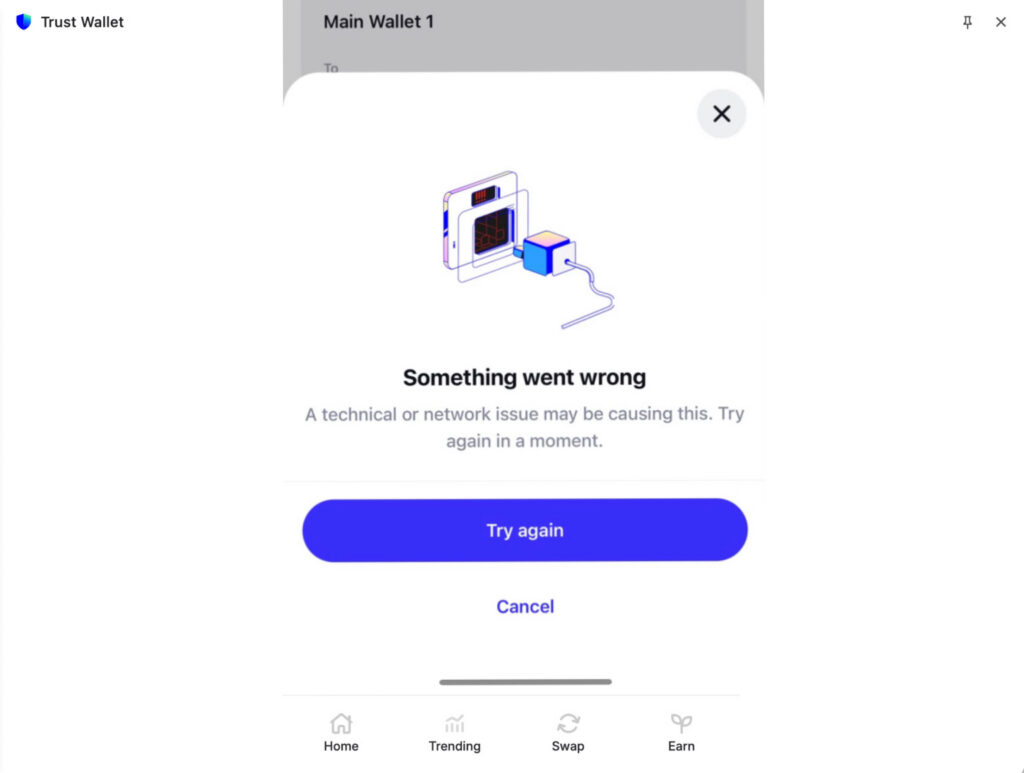
Assuming they are racing ordinary users, the victim transfers 10 to 35 TRX into the address to pay for bandwidth and energy. Within seconds, the deposited TRX is siphoned off to an external collector. Worse, any desperate attempt to sign an outgoing USDT transfer instantly throws a generic client-side modal: “Something went wrong.”
This is not a mere latency battle against a conventional off-chain sweeper bot. It is a calculated, protocol-enforced deadlock operating inside TRON’s consensus layer: Native Account Permission Management.
1. Forensic Evidence & Live State Capture
The following technical captures document the exploit chain from the original social media bait post, down through the client wallet interface, to the node consensus layer.
A. Origin Point: The Social Media Bait Post
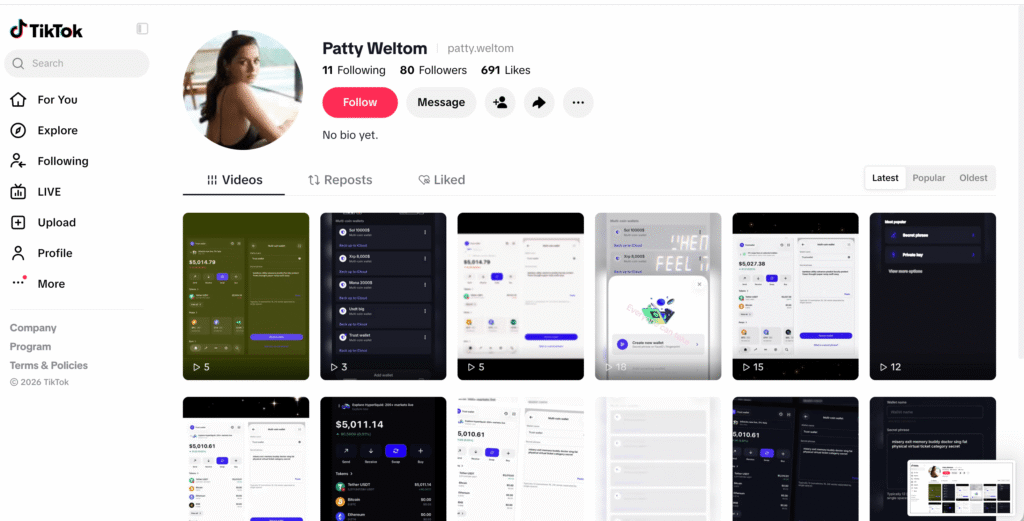
The infection vector begins off-chain. Below is a representative TikTok post matching this exact pattern — the wallet balance is showcased on-screen, framed with an urgent or naive caption, driving opportunistic viewers to import the seed phrase directly from the video or its comments/bio link.
B. The Bait Configuration in Trust Wallet
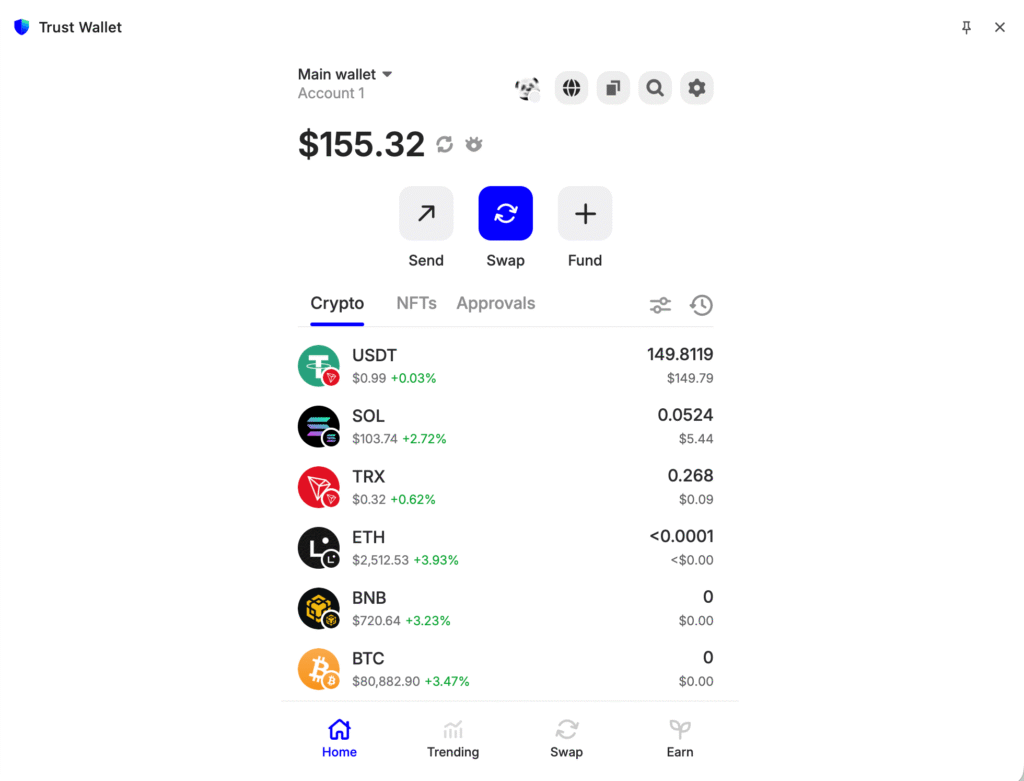
The wallet presents an attractive balance of USDT on the TRON network but holds exactly 0 TRX, forcing the user to deposit their own funds to cover the gas fees for any withdrawal attempt.
C. Sweeper Inflow and Outflow History
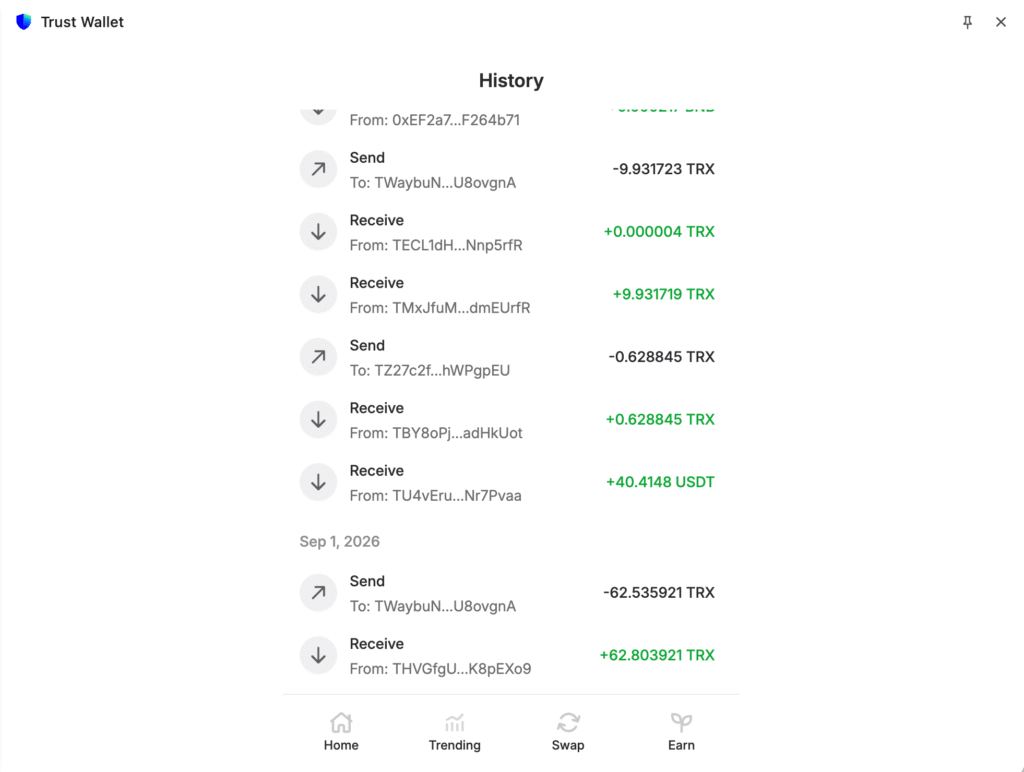
Inspecting the account history highlights repeated micro-deposits from victims attempting to supply gas fees, followed immediately by automated outbound sweep transactions executed by the attacker’s daemon within the same block or the next:
D. Client-Side Failure on TRC-20 Calls
Attempting to broadcast any USDT transfer while the account holds temporary gas results in an unhandled exception masked by Trust Wallet’s interface:
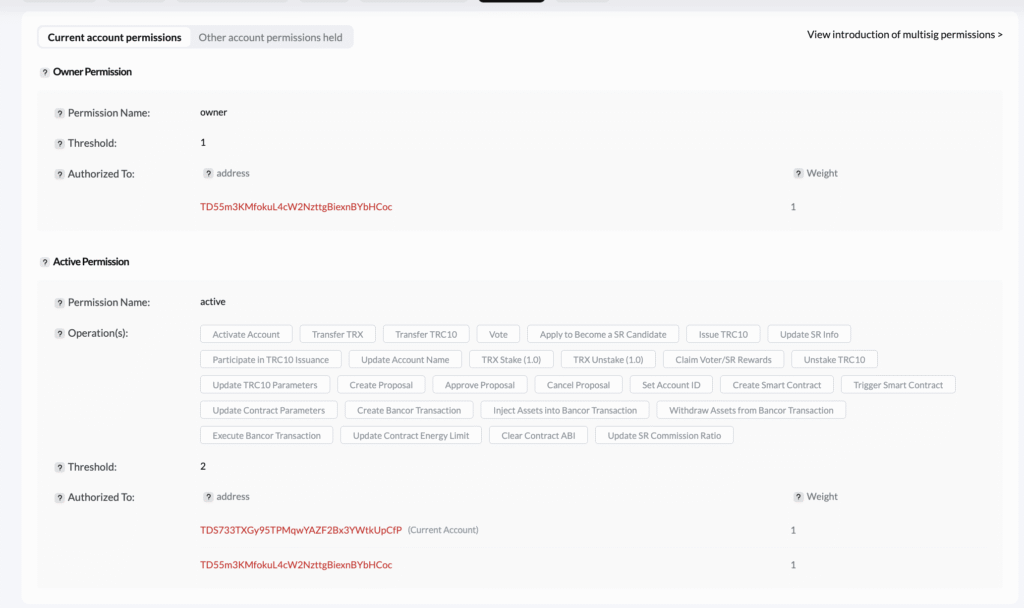
E. Protocol Permission Matrix on Tronscan
Querying the raw account configuration on Tronscan’s live permissions record for this address exposes the cryptographic mechanism barring token transfers:
2. Protocol Deep Dive: The Native Multi-Sig Architecture
Unlike EVM-based chains (such as Ethereum) where multi-signature functionality requires dedicated smart contracts, the TRON protocol implements multi-signature controls natively in the core ledger state using Google Protocol Buffers (tron.proto), as documented in TRON’s official developer guide to multi-signature.
The protocol buffer schema in tron.proto structures permissions directly within the account definition:
message Account {
  ...
  Permission owner_permission = 31;
  repeated Permission active_permissions = 32;
}
message Permission {
  enum PermissionType {
    Owner = 0;
    Witness = 1;
    Active = 2;
  }
  PermissionType type = 1;
  int32 id = 2;
  string permission_name = 3;
  int32 threshold = 4;
  int32 parent_id = 5;
  bytes operations = 6;
  repeated Key keys = 7;
}
message Key {
  bytes address = 1;
  int64 weight = 2;
}
Before leaking the mnemonic on social media, the attacker mutates the account by executing an AccountPermissionUpdateContract call. The verified on-chain parameters, confirmed directly on Tronscan’s permissions page for this account, are configured as follows:
Owner Permission
Permission Name: owner
Threshold: 1
Authorized To:
  - Address: TD55m3KMfokuL4cW2NzttgBiexnBYbHCoc (Weight: 1)
Active Permission
Permission Name: active
Threshold: 2
Operation(s): Trigger Smart Contract (and others)
Authorized To:
  - Address: TDS733TXGy95TPMqwYAZF2Bx3YWtkUpCfP (Current Account) -> Weight: 1
  - Address: TD55m3KMfokuL4cW2NzttgBiexnBYbHCoc                  -> Weight: 1
3. Cryptographic Breakdown: Why Extraction Is Mathematically Impossible
Extracting the trapped USDT via the leaked key is impossible on-chain due to two consensus-enforced rules:
1. Complete Owner Permission Lockout
In TRON, the owner permission grants absolute control, including the authority to rewrite permission tables via AccountPermissionUpdateContract. The attacker configured the owner threshold to 1 and assigned it exclusively to their external address: TD55m3KMfokuL4cW2NzttgBiexnBYbHCoc.
The address corresponding to the leaked seed phrase (TDS733...) is completely omitted from the owner list. Because the leaked key lacks owner privileges, it cannot broadcast an AccountPermissionUpdateContract transaction to remove the multi-sig restriction or reassign weights. The permission configuration is immutable to anyone holding only the leaked mnemonic.
2. The Active Permission Weight Deficit
USDT on TRON is a TRC-20 smart contract token. Executing a transfer requires invoking the transfer(address,uint256) entrypoint on the official USDT contract (TR7NHqJEKQxGTCi8q8ZY4pL8otSzgjLj6t), an action governed by the TriggerSmartContract operation.
Under TRON consensus, an active permission transaction is valid if and only if the sum of the weights is greater than or equal to the threshold:
∑ Weight ≥ Threshold
Examining the account’s active permission settings:
- The required Threshold is set to 2.
- The leaked key (
TDS733...) provides a weight of exactly 1. - The remaining signature must originate from the attacker’s secondary key (
TD55m3...), which is never leaked.
When a victim or custom script signs a TRC-20 transfer using solely the leaked key, the payload contains only one signature. The validating Super Representative (SR) node evaluates the signature weight during message validation and rejects the broadcast at the RPC gateway with an explicit consensus exception:
class org.tron.core.exception.ValidateSignatureException: Validate Signature error: signature weight is not enough!Consumer mobile wallets cannot contextualize this consensus exception for single-user accounts, falling back to: “Something went wrong.”
4. The Sweeper Engine: Automated Gas Harvesting
While the trapped USDT remains permanently immobilized, any TRX deposited to pay for gas remains liquid and transferable via single-key operations. The attacker connects an automated daemon directly to a TRON node via ZeroMQ or gRPC (block_witness / transaction_stream).
Developers who try to outpace the sweeper using polling scripts querying /wallet/getaccount via REST endpoints face structural block timing limits:
- TRON operates on Delegated Proof of Stake (DPoS) with a strict 3-second block interval.
- By the time an HTTP polling loop receives a balance change, the transaction is already finalized in a block.
- The attacker’s sweeper detects the incoming
TransferContracttransaction in the mempool or at block ingestion and broadcasts an immediate counter-transfer signed with a high fee limit. - The native TRX is routed to the attacker’s staging address (
TWaybu...ovgnA) in under 3 seconds.
Reproduction Script: Verifying the Consensus Lock
The following Node.js script proves why single-key signing fails on-chain, independent of balance or execution speed. It is intended strictly for verification/research purposes on an account you control or are authorized to test — not as a withdrawal tool against real honeypot addresses:
const TronWeb = require('tronweb');
const HttpProvider = TronWeb.providers.HttpProvider;
const fullNode = new HttpProvider('https://api.trongrid.io');
const solidityNode = new HttpProvider('https://api.trongrid.io');
const eventServer = new HttpProvider('https://api.trongrid.io');
// Private key derived from the leaked mnemonic (Weight: 1)
const victimPrivateKey = 'LEAKED_PRIVATE_KEY_HERE';
const tronWeb = new TronWeb(fullNode, solidityNode, eventServer, victimPrivateKey);
const usdtContractAddress = 'TR7NHqJEKQxGTCi8q8ZY4pL8otSzgjLj6t';
const destinationAddress = 'RESCUER_SAFE_ADDRESS_HERE';
async function attemptExtraction() {
  try {
    const contract = await tronWeb.contract().at(usdtContractAddress);

    // Calls TriggerSmartContract
    const result = await contract.transfer(destinationAddress, 1000000).send({
      feeLimit: 100000000
    });

    console.log('[+] Success TX:', result);
  } catch (error) {
    // Expected output:
    // class org.tron.core.exception.ValidateSignatureException:
    // Validate Signature error: signature weight is not enough!
    console.error('[-] Extraction Failed at Consensus Layer:', error);
  }
}
attemptExtraction();
5. Why EVM Flashbot Tactics Fail on TRON
Security engineers familiar with EVM networks often test two common rescue strategies, both of which fail on TRON due to protocol architecture:
| Rescue Strategy | EVM Architecture | TRON Architecture | Outcome on TRON Honeypot |
|---|---|---|---|
| Private Mempools (Flashbots) | Whitehats submit gas funding and token transfers as an atomic bundle directly to block builders. | TRON has no open, permissionless private bundle relay. Transactions broadcast over public gossip. | Failed: Sweeper detects the incoming TRX and drains it in the next block. |
| Energy & Bandwidth Delegation | Account abstraction / Paymasters (ERC-4337) allow external gas sponsorship. | External accounts can delegate native Energy and Bandwidth directly to the victim, bypassing the need for TRX. | Failed: Even with zero TRX needed, the USDT transfer fails validation because Key Weight (1) < Active Threshold (2). |
6. Economic Structure: Sunk Bait vs. Cumulative Exploitation
The USDT balance sitting in the wallet is an intentional, unrecoverable operational expense: a permanent sunk cost.
- Sunk Capital: The bait USDT deposited once, then permanently locked behind the multi-sig threshold.
- Victim Inflow: an estimated 15 to 40 victims daily, depositing 10 to 35 TRX per attempt, based on the observed sweeper transaction cadence for this address.
- Yield: a steady daily stream of stolen TRX gas per honeypot address.
- Amortization: the attacker quickly recovers the initial bait within the first 24 to 72 hours of publishing the mnemonic across social channels, generating ongoing automated profit thereafter.
Note: the behavioral estimates above are derived from the observed pattern of inflow/outflow transactions on this account, not confirmed attacker revenue.
7. Forensic Investigation & Threat Disruption
Because the consensus model prevents programmatic recovery of trapped funds, security researchers should focus on disrupting distribution channels and liquidations.
Step 1: On-Chain Pre-Flight Inspection
Before testing an exposed seed phrase or sending gas, inspect the target on Tronscan — see the live example for this case at tronscan.org/address/TDS733TXGy95TPMqwYAZF2Bx3YWtkUpCfP/permissions:
- Navigate to Account Details → Permission.
- Verify the Active Permission threshold. If
Threshold > 1while the exposed address has a weight of1, or if the account’sownerpermission belongs to an unknown third party, the wallet is a confirmed multi-sig trap.
Step 2: Advanced On-Chain Heuristics & Exchange Tracing
Sweeper addresses are transient. They do not hold stolen TRX indefinitely; they act as funnels aggregating micro-deposits into centralized liquidation points. To track this:
- Identify the Aggregator: Trace the outgoing
TransferContracttransactions from the frontline sweeper (e.g.,TWaybu...ovgnA). You will typically find a Tier-2 consolidation address where hundreds of 10-35 TRX transactions merge. - Utilize Graphing Tools: Use on-chain intelligence tools like Bitquery, Breadcrumbs.app, or Tronscan’s native Data Graph feature to visualize the outflow tree.
- Locate the CEX Deposit Address: Follow the consolidation nodes until the TRX hits an address officially tagged as a Centralized Exchange (CEX) Hot Wallet (e.g., Binance-Hot-8, OKX-Hot, or Bybit). The address immediately preceding this hot wallet is the attacker’s personal CEX deposit address.
Step 3: Drafting the Takedown Dossier (AML Escalation)
Once you map the flow to a CEX, you can trigger an Anti-Money Laundering (AML) freeze. Centralized exchanges are legally obligated to act against automated scam infrastructure. Prepare a dossier containing:
- The Exploit Vector: The original social media post (TikTok/X URL).
- The Honeypot Proof: A link to the Tronscan permissions page showing the malicious
AccountPermissionUpdateContractlock. - The Chain of Custody: An unbroken list of
TxIDsproving the TRX moved from the Honeypot → Sweeper → Consolidation Wallet → CEX Deposit Address.
Submit this payload directly to the exchange’s legal and security contacts (e.g., [email protected], [email protected]). Because the transactions represent automated, programmatic theft, exchanges will typically lock the account and seize the assets pending KYC verification and investigation.
Step 4: Explorer Flagging & Threat Intelligence
Submit a formal malicious account report via Tronscan. Adding a public Scam / Phishing tag updates threat intelligence feeds consumed by non-custodial wallets (including Trust Wallet and MetaMask), proactively warning users before any transaction is signed.
Key Takeaways
- A “free” wallet with a visible USDT balance and near-zero TRX is a red flag, not luck.
- TRON’s native
owner/activepermission split lets an attacker permanently detach a leaked key from spending rights — this is not a bug, it’s the protocol working exactly as designed, just weaponized. - Always check Account → Permissions on Tronscan before funding any wallet recovered from a leaked seed phrase.
- Any TRX sent as “gas” to such an address is swept within one block (~3 seconds) — there is no outrunning it with polling scripts.
